WARNING: This review contains spoilers.
My sister recommended Shelby Van Pelt’s Remarkably Bright Creatures, and since we rarely recommend books to each other, I took her recommendation seriously and immediately bought the audiobook.
Before I describe my reactions to the novel, let’s get two things out of the way: One, I enjoyed it, and two, I have a profound respect for anyone who successfully completes a novel, not to mention one that gets published and then goes on to achieve a broad readership. There’s no arguing that this book is a success that any writer (including this one) would be rightfully proud of.
That said, while I would recommend this novel as an entertaining read, I do have a couple of issues with it. One, the novel reads like a first novel displaying some of the defects first novels are prone to. These are far from serious flaws, in my opinion, but I wanted to mention them because I noticed them and you might too. I don’t think they detract from the pleasure of reading the book.
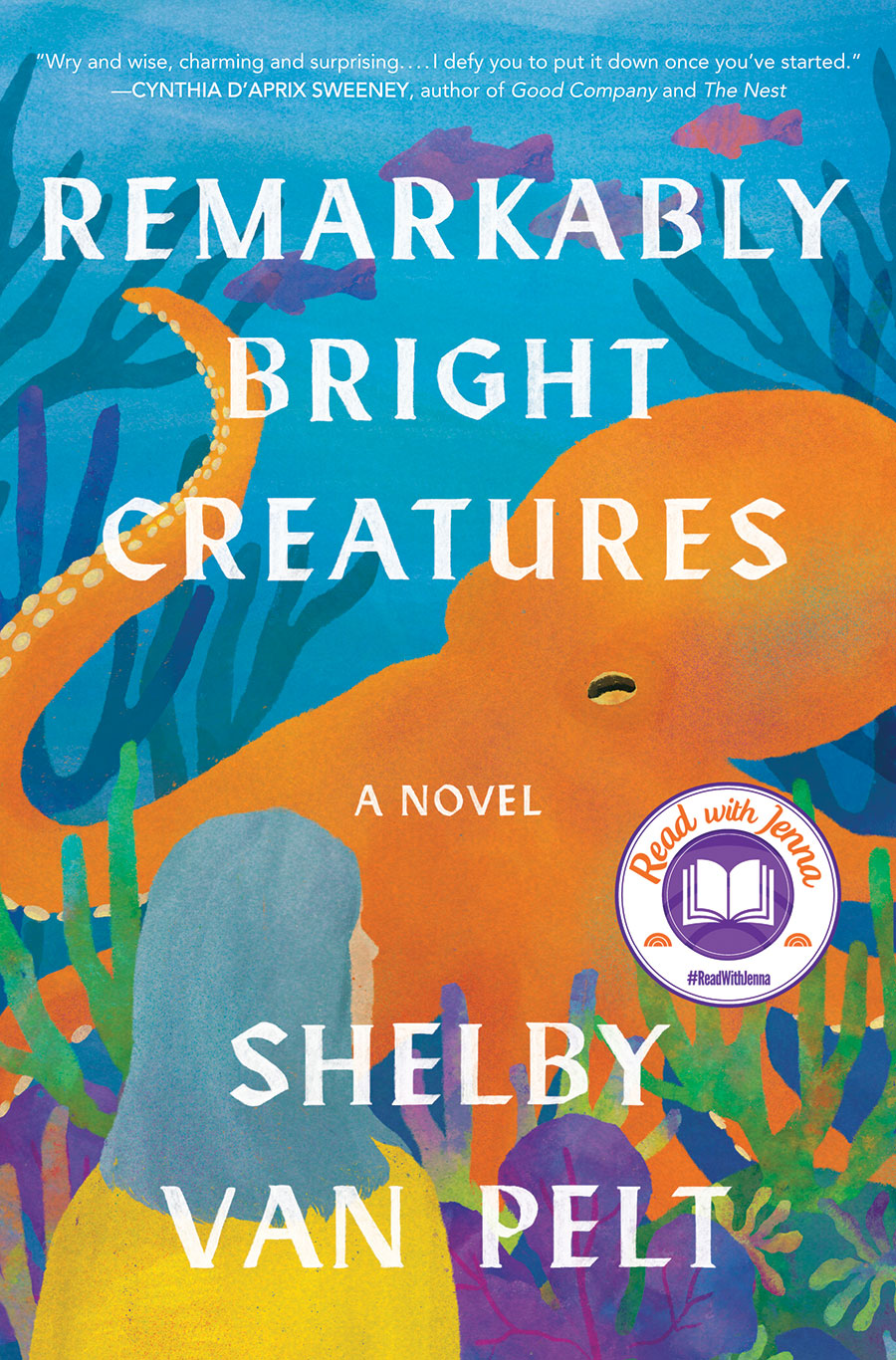
Two, the octopus as a character. The book’s cover makes it clear that an octopus plays a central role in the story, so that’s no spoiler, but what surprised me was how much of a role Marcellus (the octopus) plays. Whole chapters are told from his point of view.
While I admire the author’s dedication to this creative conceit, it got a little far-out and distracting at times. I’ve read a lot of science-fiction and fantasy over the years, and I’m pretty good at suspending my disbelief. I can easily forget that wizards, wyverns, and wookies aren’t real. But Marcellus the octopus is not just remarkably bright, he’s almost omniscient in his understanding of the humans around him and the situations they’re in. It was a tough pill to swallow.
So, backing up a bit: Set in Sowell Bay, a fictional town on the shores of Washington’s Puget Sound, the novel centers on the relationship between Tova, a woman in her 70s who works at the local aquarium, and Marcellus, a giant Pacific octopus and the aquarium’s most intelligent resident.
One evening, Tova discovers Marcellus—who has a habit of escaping his tank to explore his surroundings and nosh on some off the sea creatures in nearby displays—trapped in a tangle of power cords. After rescuing the octopus and helping him back to his tank, Tova develops an unlikely (to say the least) relationship with the creature, who it turns out, has at least human-level intelligence and a talent for observation even Sherlock Holmes would envy. Remarkably bright indeed!
At the center of the novel lies a mystery: In 1989, Tova’s eighteen-year-old son, Erik, disappeared from his small sailboat. The police believe he committed suicide, a conclusion Tova has never accepted. Now, 30 years later, she’s still no closer to knowing what actually happened to her son.
Three decades have done little to diminish Tova’s grief at losing her only child. Now a widow, she is alone and increasingly alienated from her ever-shrinking group of elderly friends who have children and grandchildren to occupy their lives.
Hundreds of miles away in California, thirty-year-old Cameron, another lost soul, can’t seem to get his life together. He discovers an old photo of Daphne, the drug-addicted mother who abandoned him, posing with a young man he doesn’t recognize. Along with the photo is a boy’s class ring from Sowell Bay High School. This is the first clue Cameron’s ever had as to who his father might be, so he travels to Sowell Bay to look for him.
You can see where this is going.
Of course Tova and Cameron turn out to have a connection: Tova’s son, Erik, fathered Cameron shortly before he disappeared. Tova is Cameron’s grandmother, and Marcellus—despite being confined to a saltwater tank, for the most part—is somehow the one who manages to bring them together, with the help of some amazing coincidences, such as Cameron just happening to get a job at the aquarium.
Summarized this way, the premise sounds sillier than it actually came seemed I was reading it. Remarkably Bright Creatures is described by readers as a heartwarming story, and indeed it is, which I think is one reason the novel ends up working. I found myself liking Tova and Cameron, and I felt sorry for them. I wanted them to find each other, which helped me (and I imagine most readers) overlook those instances when the idea of an octopus as a wise, if somewhat cranky, narrator became a little too much.

My disappointment with Remarkably Bright Creatures might have been my own misplaced expectations. I thought it was going to be a classic murder mystery with the participants (including Marcellus) cracking the case, confronting the perpetrator, narrowly averting death, and in the end, seeing justice served. But that’s not what happens, and I spent a good half of the book feeling mildly frustrated until it became clear to me that this wasn’t a murder mystery after all but a straightforward relationship story (Tova and Marcellus; Tova and Cameron). Neither a suicide nor a murder, Erik’s death turns out to merely have been an accident.
So, there’s no murder mystery, but there is a mystery for Tova: What really happened to her son? Answering that question seems necessary for her to finally achieve some measure of peace.
One important detail that emerges: Her son is dead. Before he was captured by the aquarium, Marcellus came across Erik’s remains—which at this point amount to bits of clothing and a house key—at the bottom of Puget Sound. When Tova loses her own house key in the aquarium facilities, Marcellus retrieves it and recognizes it as having the same exact shape at the one he found in Puget Sound, thus making the connection. Apparently octopuses have amazing memories and abilities to recognize patterns.
Unfortunately, Marcellus can’t communicate this detail to Tova, but that’s okay since Tova doesn’t seem to think her son is still alive anyway. She just doesn’t believe he committed suicide.
Through random encounters with townspeople, including a former friend of Erik’s who has returned to Sowell Bay as a middle-aged adult, Tova finally learns that at the time of his disappearance, Erik had a secret girlfriend. It’s the first new information she’s gotten about her son in decades.
She learns more about this mysterious girlfriend, who happens to be Cameron’s mom, Daphne, from Cameron himself, but his knowledge is limited since Daphne wasn’t much involved in his life. The final piece of the puzzle that Tova gets comes from such a far-out source that it’s difficult to describe.
Having journeyed from California to Sowell Bay to track down his father, Cameron meets Avery, a woman who owns the local surf shop. They begin dating. Avery discloses that she once saved the life of a woman who jumped from the town pier into the frigid waters of the North Pacific. Avery heard the woman say, “boom,” before she leapt. It’s implied that this woman was Cameron’s mom although this is never confirmed.
Hearing this story, Tova speculates that “boom” means the part of a sailboat’s rigging that swings around (as opposed to the sound of an explosion), and imagines a swinging boom knocking her son off his sailboat and into the sea. Perhaps Daphne was with him when this happened and she just never reported it to anyone?
It’s a tenuous resolution to the mystery that has long haunted Tova’s life, but she seems satisfied with it. At the end of the novel she has her grandson in her life, which in some deep way fills the void that her son’s disappearance created.
But wait, what was the point of Marcellus again?
That’s where for me Remarkably Bright Creatures reads like a first novel. It seemed like it was going in one direction, and then it veered off in another as if the author had trouble making the premise work. I thought solving the mystery of Erik’s disappearance would be more important to Tova’s transformation from isolated, grieving widow to connected, resilient grandmother even if it didn’t involve solving a murder mystery. And I think it was reasonable for me to expect that Marcellus would at least play more of a role in that resolution—otherwise why go through all the trouble of including him?
I can easily imagine a different, more conventional novel where Tova and Cameron meet at the aquarium, bond over their affection for Marcellus, whose point of view remains unexplored, and eventually discover their familial connection, which changes their lives. You could possibly add a scuba diver happening upon Erik’s remains, giving her a little more closure about her son’s fate.
It would basically be the same story but without the supernatural element of an octopus invested with human intelligence. Call it, Unremarkably Bright Creatures. Yes, without the hook of an octopus as a main character, the novel would hardly have attracted so much attention from publishers and readers, but it would have avoided the central problem of fitting Marcellus into the story as an actor with some agency rather than a frustrated observer.
Don’t get me wrong, I really love the central premise of an octopus as a character, especially in light of news stories from the past several years of real-life octopuses escaping their tanks and proving to be far more clever than people expect. I know I’m not alone in being fascinated by these eight-armed, alien-looking sea creatures.
But the book’s excellent premise turned out to be incredibly difficult to execute in a coherent manner within the context of this story. I think Shelby Van Pelt did a great job trying to make it work, and obviously the novel has been received well, to put it mildly. As of December 2025, the book had more than 124,000 reviews on Amazon with an average rating of 4.6 stars.
But the bottom line for me is that as a reader I was disappointed with the ending relying so heavily on the Tova-Cameron relationship and less on solving the central mystery or the octopus playing a critical role in the resolution. The author does contrive to bring Marcellus back into the story by having him escape his tank one last time (he’s at the end of his natural lifespan) and place Erik’s class ring where Tova is sure to find it. Cameron had tossed it into the aquarium after having given up on finding his dad. But this seemed a little clunky to me and hardly warranted all the chapters told from Marcellus’ point of view, in my opinion.
What more could an octopus conceivably do? Not much, which is the flaw in the premise. Setting up a mystery and giving readers access to the thoughts of an octopus promised one kind of story, but what was delivered was something far more conventional, and I really don’t see how it could have been otherwise.
So while I was disappointed as a reader, as an aspiring writer I loved thinking about the challenges Shelby Van Pelt faced in bringing the central premise to fruition and why I felt like it went off track.
What if Van Pelt had made Erik’s ghost one of the main characters instead, and we readers get our answers by way of his thoughts and memories? That seems like it would have been much easier to execute since you could write your own rules as far as to what extent ghosts can communicate with the living.
Reading Remarkably Bright Creatures reminded me of Alice Sebold’s The Lovely Bones, which is told from the perspective of a murdered 14-year-old girl. As a ghost, she has very limited agency (if I remember correctly) and can only observe her family as they grieve her loss, but at least she doesn’t face the limitation of being confined to a saltwater tank as Marcellus does (for the most part). And if Sebold had chosen to give the ghost the ability to communicate with the story’s living characters, it would have been easy for readers to accept, communication with the dead having a long tradition in fiction, not to mention those who believe that such a thing is possible in real life.
And what if you ditched verisimilitude entirely and made Marcellus a talking octopus? (Or telepathic?) Okay, I’m not interested in that story, and I don’t expect Shelby Van Pelt would have been either, but it does solve some of the problems of having an important, POV character sidelined by the simple fact that he’s an octopus with severely limited mobility and ability to communicate.
I’ll conclude by saying that I’m grateful to Shelby Van Pelt for having written a novel that I enjoyed both reading and thinking about, even if that meant probing at length what I perceived its defects to be.
Van Pelt, Shelby. Remarkably Bright Creatures. New York: Ecco Press: 2022.
Order Remarkably Bright Creatures from
About Me: My name is Frank Swanson, and I’m an editor and technical writer. I have a lot of different interests: writing, reading, history, science, science-fiction, movies, philosophy, religion, and self-improvement. I’m particularly interested in stories and how they work. Whether it’s a short story, a novel, a movie or a TV show, if it does something interesting or that deeply affects me, I want to examine how it does what it does.
Want to connect? Reach me through my Contact Page.

 The Swansonian